Hyperparameter Optimization
Author(s): Anna Lappe (CERN), Matteo Bunino (CERN)
Hyperparameter optimization (HPO) is a core technique for improving machine learning model performance. This page introduces the concepts behind HPO, covering key elements like hyperparameters, search algorithms, schedulers, and more. It also outlines the benefits and drawbacks of HPO, helping you make informed decisions when applying it with itwinai.
Key Concepts
Hyperparameters are parameters in a machine learning model or training process that are set before training begins. They are not learned from the data but can have a significant impact on the model’s performance and training efficiency. Examples of hyperparameters include:
Learning rate
Batch size
Number of layers in a neural network
Regularization coefficients (e.g., L2 penalty)
HPO is the process of systematically searching for the optimal set of hyperparameters to maximize model performance on a given task.
The search space defines the range of values each hyperparameter can take. It may include discrete values (e.g., [32, 64, 128]) or continuous ranges (e.g., learning rate from 1e-5 to 1e-1).
Search algorithms explore the hyperparameter search space to identify the best configuration. Common approaches include:
Grid Search: Exhaustive search over all combinations of hyperparameter values.
Random Search: Randomly samples combinations from the search space.
Bayesian Optimization: Uses a probabilistic surrogate model to learn the shape of the search space and predict promising configurations.
Evolutionary Algorithms: Use search algorithms based on evolutionary concepts to evolve hyperparameter configurations, e.g. genetic programming.
Schedulers manage the allocation of computational resources across multiple hyperparameter configurations. They help prioritize promising configurations and terminate less effective ones early to save resources. Examples include:
ASHA (Asynchronous Successive Halving Algorithm): Allocates resources by successively discarding the lowest-performing hyperparameter combinations.
Median Stopping Rule: Stops trials that perform below the median of completed trials.
The evaluation metric determines the performance of a model on a validation set. Common metrics include accuracy, F1 score, and mean squared error. The choice of metric depends on the task and its goals.
A trial is the evaluation of one set of hyperparameters. Depending on whether you are using a scheduler, this could be the entire training run, so as many epochs as you have specified, or it could be terminated early and thus run for fewer epochs.
Example of HPO on the EURAC use case
The following is an example of HPO on the EURAC use case. We asked a domain expert to
suggest their best guess for high-performing hyperparameters
suggest an appropriate hyperparameter search space for HPO
We then ran the parameters that the developer thought would perform best as an isolated trial and performed HPO using random search, running 28 trials of 40 epochs each within the suggested search space. You can see the resulting validation losses in the following plot:
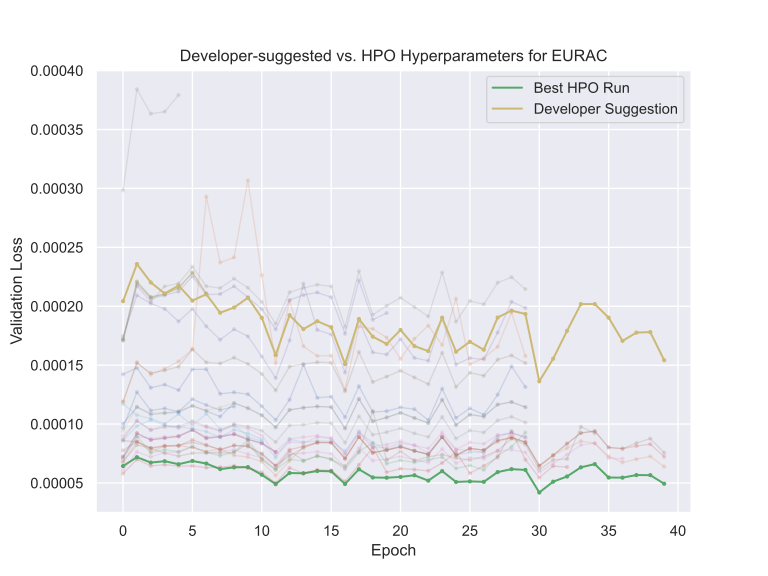
As we can see, the best HPO run is considerably better, achieving a validation loss three times lower than the developer’s suggested parameters. This shows that even a domain expert may miss substantial performance gains by not utilizing HPO.
When to Use HPO and Key Considerations
HPO can significantly enhance a model’s predictive accuracy and generalization to unseen data by finding the best hyperparameter settings. However, there are some drawbacks, especially with regards to computational cost and resource management. Especially distributed HPO requires careful planning of computational resources to avoid bottlenecks or excessive costs. You should consider that if you want to run four different trials, and you run them on the same amount of resources as you normally would, your training would run four times as long.
Because of this, we want to design our HPO training wisely, so that we avoid unneseccary computational cost. These are some things that might help you when you are getting started with HPO.
HPO is beneficial when:
model performance is sensitive to hyperparameter settings.
you have access to sufficient computational resources.
good hyperparameter settings are difficult to determine manually.
To make sure you get the most out of your HPO training, the are some considerations you might want to make are to
define the search space wisely: Narrow the search space to plausible ranges to improve efficiency.
choose appropriate metrics: Use metrics aligned with your task’s goals. With some search algorithms it is also possible to do multi-objective optimization, e.g. if you want to track both accuracy and L1 loss - just make sure that the metric that you track conforms with your search algorithm.
allocate your resources strategically: Balance the computational cost with the expected performance gains. This is what the scheduler is for, and it is generally always a good idea to use one, unless you expect your objective function to be extremely heterogenous, i.e. that the performance of a hyperparameter configuration on the first (for example) ten epochs is not a good indicator for its future performance at all. You might also have experience in training your model and want to account for additional behaviors – for this there are additional parameters you may set, such as a grace period (a minimum number of iterations a configuration is allowed to run).
Hyperparameter Optimization in itwinai
Now that we know the key concepts behind HPO, we can explore how these are implemented in
itwinai. The itwinai TorchTrainer has HPO functionalities
already built-in, which means no extra scripts and you can run it as you normally would in any
itwinai pipeline. In the next section we’ll introduce distributed HPO, and discover how we can
easily start optimizing hyperparameters in our exisiting itwinai pipeline with just a few lines
of code. We will then describe the architecture and operation of the
TorchTrainer and talk about what to consider when choosing the
best HPO integration for you.
Ray Overview
Under the hood, we use an open-source framework called Ray to facilitate distributed HPO. Ray provides two key components used in itwinai:
Ray Train: A module for distributed model training.
Ray Tune: A framework for hyperparameter optimization, supporting a variety of search algorithms and schedulers.
Ray uses its own cluster architecture to distribute training and HPO. A ray cluster consists of a group of nodes that work together to execute distributed tasks. Each node can contribute computational resources, and Ray schedules and manages these resources.
How a Ray Cluster Operates:
Node Roles: A cluster includes a head node (orchestrator) and worker nodes (executors).
Task Scheduling: Ray automatically schedules trials across nodes based on available resources.
Shared State: Nodes share data such as checkpoints and trial results via a central storage path.
We launch a ray cluster using a dedicated slurm job script that you can find in related tutorials. Also refer to the ray documentation on this topic, if you want to learn more about how to launch a ray cluster with slurm.
How to Tune your model with itwinai
The itwinai TorchTrainer combines components from Ray Train
and Ray Tune, providing
a fully distributed approach to hyperparameter optimization (HPO) and machine learning
training. It enables distributed machine learning within HPO, allowing each independent trial
to run in a distributed manner. This method is ideal for large-scale experiments that require
optimized resource utilization across multiple nodes.
Key features of the TorchTrainer:
Seamless Integration: Works with all itwinai components, such as loggers, data getters, and splitters.
Flexibility: Supports various search algorithms and schedulers from Ray Tune.
Minimal Code Changes: Easily integrates into existing itwinai pipelines with minimal modifications.
Note
Do not wrap the TorchTrainer into Ray’s Tuner
manually, as the trainer already uses the tuner under the hood, and doing so would create
two tuners.
For a hands-on tutorial on setting up distributed HPO with itwinai, check out the distributed HPO tutorial.
Further References on Hyperparameter Optimization
Some of these talks are short; others more in-depth. All are highly recommended:
Key papers on popular hyperparameter-optimization algorithms (you needn’t read them all immediately, but they’re great to bookmark):
Also, see the Ray Tune key-concepts overview for a concise tour of HPO in Ray: Ray Tune Key Concepts.