Scalability Report
The itwinai Scalability Report provides insights into how well your model’s performance
scales when training across multiple GPUs and nodes. It can be used to find bottlenecks or bugs
as you distribute your workload, as well as help you monitor your model’s sustainability. The
main goals are as follows:
Understand how well your model scales with regards to the given metrics
Discover which distribution strategy works best for your pipeline
The Scalability Report includes the following metrics:
Average time per epoch
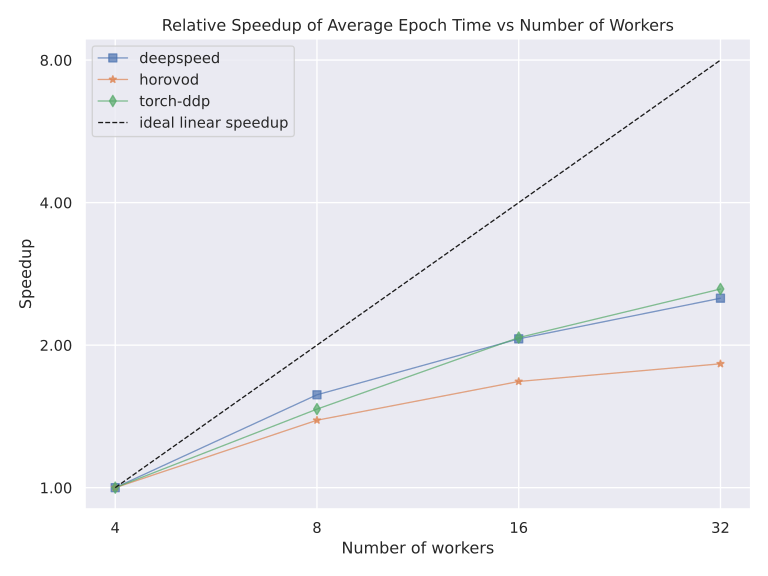
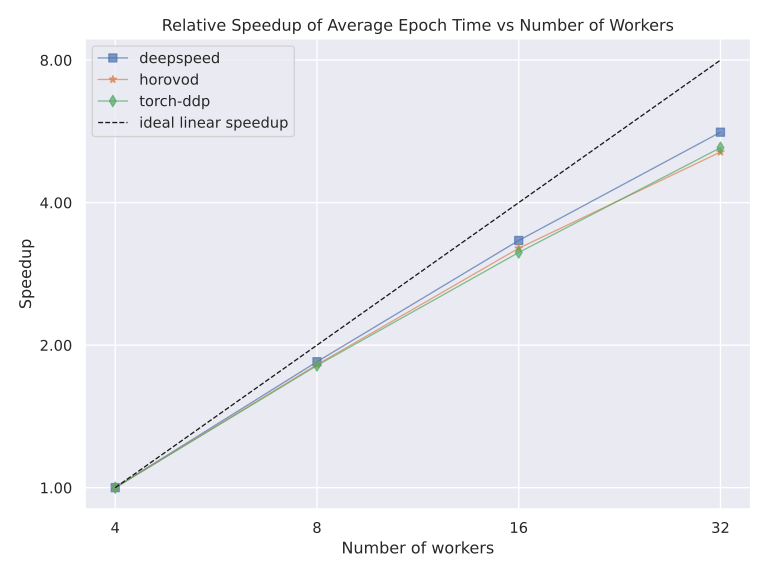
Relative speedup of time per epoch
GPU Utilization (0-100%)
GPU Power Consumption (watt-hours)
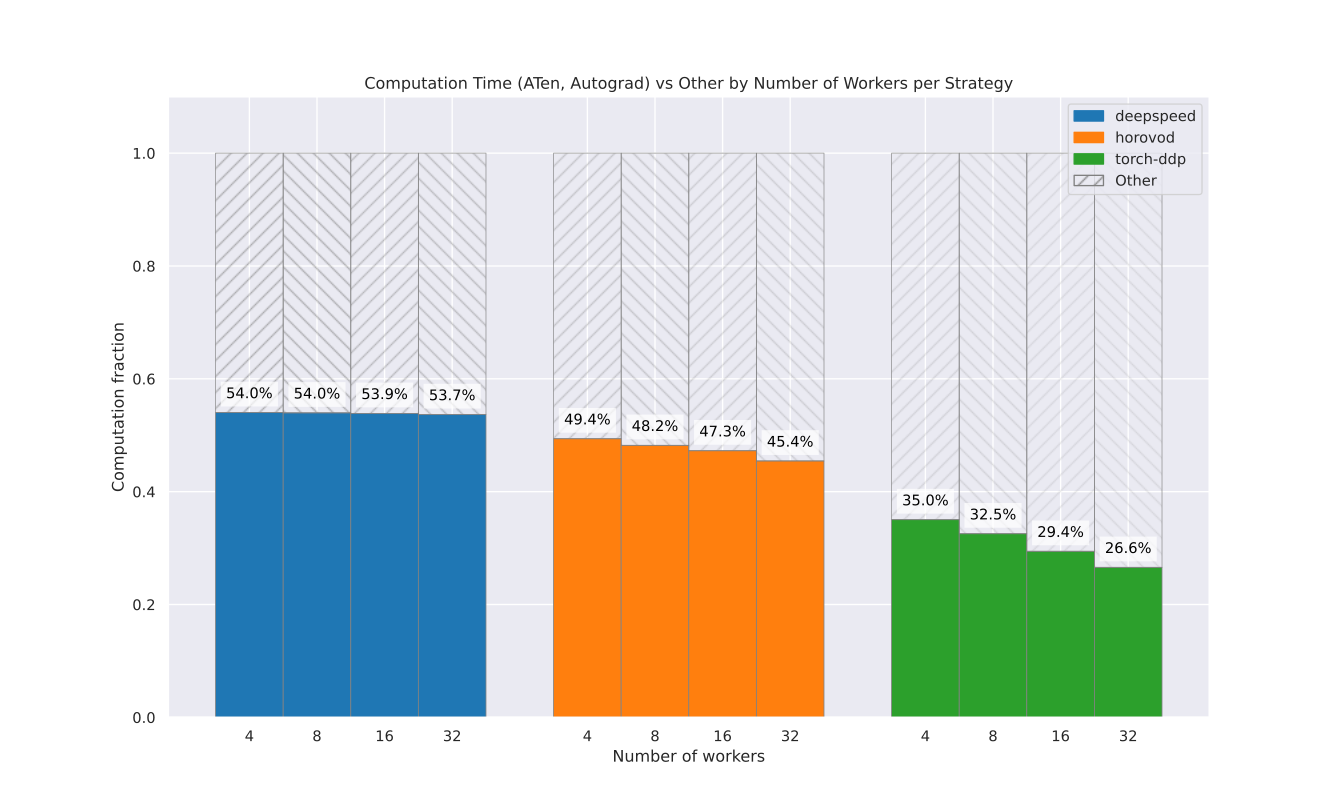
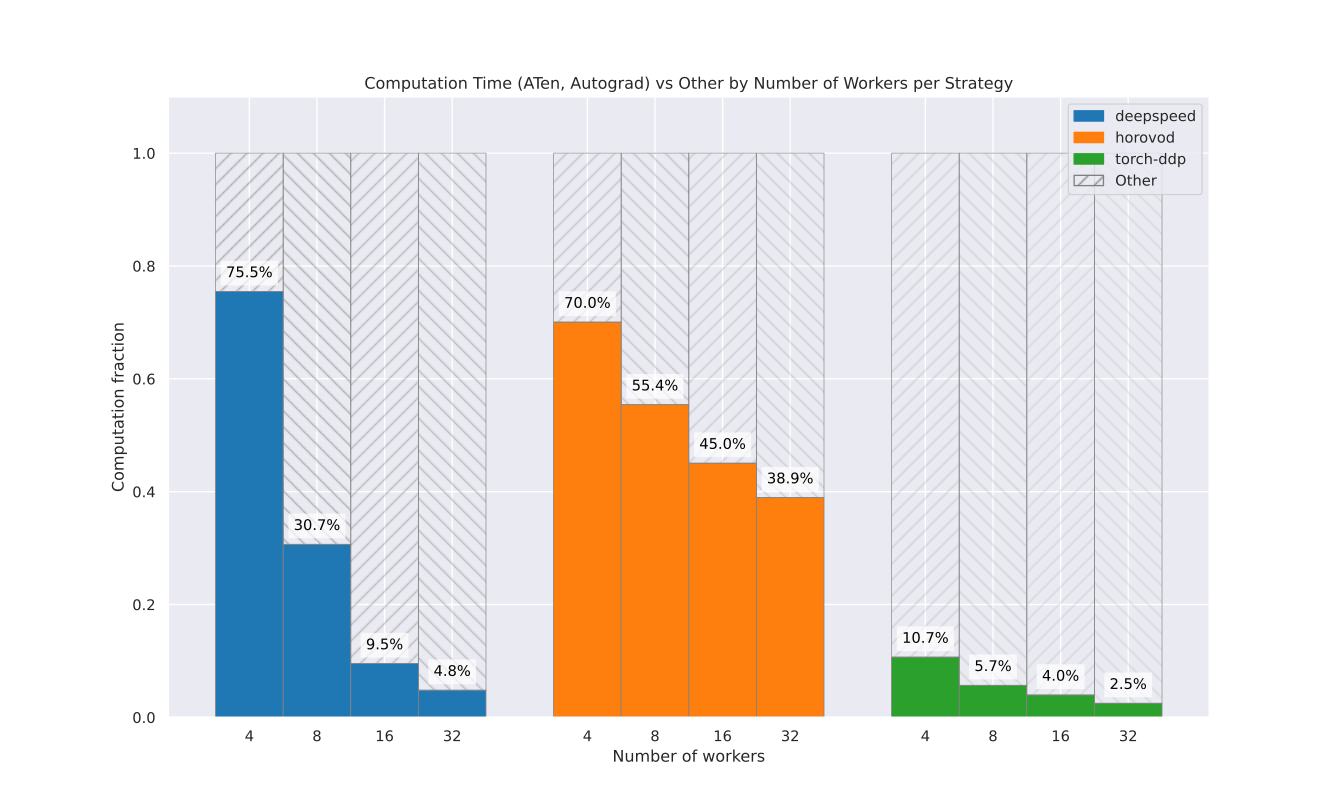
Computation vs. other
For more information about profiling with itwinai, you can have a look at the
profiling overview.
Note
To use the Scalability Report functionality of itwinai, you need to use a Trainer object
that inherits the itwinai TorchTrainer.
Generating the Data
To generate the data, you have to train a model with the various profilers enabled, which can be toggled using the following flags in your training configuration:
steps:
 - ...
 - _target_: <your-trainer-class>
   measure_gpu_data: True  # Measures GPU utilization and power consumption
   enable_torch_profiling: True  # Enable profiling for comparing comm. time vs. other
   store_torch_profiling_traces: True # Store the traces from the profiling (requires setting enable_torch_profiler to True)
   measure_epoch_time: True  # Measures avg. epoch time and rel. speedup
   ...
enable_torch_profiling will aggregate the times spent on unique operations.
The raw traces are stored with store_torch_profiling_traces. As the traces
quickly get quite large, we advise you to keep the run time as short as
acceptable for meaningful results. You can also tinker with the
profiling_warmup_epochs, profiling_wait_epochs and
profiling_active_epochs parameters to control how many epochs are profiled
and when the profiling starts. The warmup epochs will run first, then it alternates
between the wait epochs and the active epochs, where the profiling is
done until all epochs are done.
Enabling the torch profiling will have a severe impact on runtime, so it is recommended to measure epoch time and GPU data (utilization and power consumption) in separation for the most realistic results.
The epoch time is measured inside the train() function of the
TorchTrainer, while the remaining metrics are measured using the following
decorators:
PyTorch Profiler: This profiler measures the time spent in computation vs. other operations in your distributed machine learning. This is done by comparing the time spent in PyTorch’s ATen—i.e. computation—with any other operations. It uses the PyTorch Profiler to retrieve this information and is enabled using the
enable_torch_profilingflag.GPU Data Profiler: This profiler measures the GPU utilization and the total power consumption of the training. This is done by probing the GPU at a pre-defined interval and retrieving the needed data. The data from the GPU data profiler is saved to MLFlow and therefore not a part of the generate-scalability-report command.
If you overwrite the TorchTrainer’s train() method, then the decorators need to
be placed above your overwritten train() method as in the following example:
from itwinai.torch.monitoring.monitoring import measure_gpu_utilization
from itwinai.torch.profiling.profiler import profile_torch_trainer

class MyTrainer(TorchTrainer):
   ...

   @profile_torch_trainer
   @measure_gpu_utilization
   def train(self, ...):
      # Your train method here
If your profilers are enabled in the configuration—and if applicable, your decorators have been
appropriately positioned above your train() method—then this will create a directory named
scalability-metrics in the current working directory, under which three subdirectories will
be created:
epoch-time: The wall-clock time data from theEpochTimeTrackercomputation-data: The computation overhead data
The GPU data will be written to MLFlow.
Generating the Report
You can generate the report using the following command:
itwinai generate-scalability-report --experiment-name <mlflow_experiment_name>
This command takes in some extra arguments that can be viewed with the --help flag:
itwinai generate-scalability-report --help
This command fetches the data from mlflow.
If the --tracking_uri flag is not specified, it expects the data in ./mllogs/mlflow.
You can specify specific runs with the --run-names flag. Per default all runs in the experiment
are used.
Example Results
The following will show some examples of scalability reports. In particular, it will show results from the MNIST plugin and from the Virgo use case. The Virgo use case scales fairly well, while the MNIST case does not, and this is reflected in the plots.
The reason for the poor scaling of the MNIST use case is likely that the dataset is quite small, resulting in the overhead of distribution taking up a significant portion of the final training time. The report results in a table of scalability results—printed in the console—as well as plots showing the same results visually. An example of the resulting console output can be seen here.
MNIST
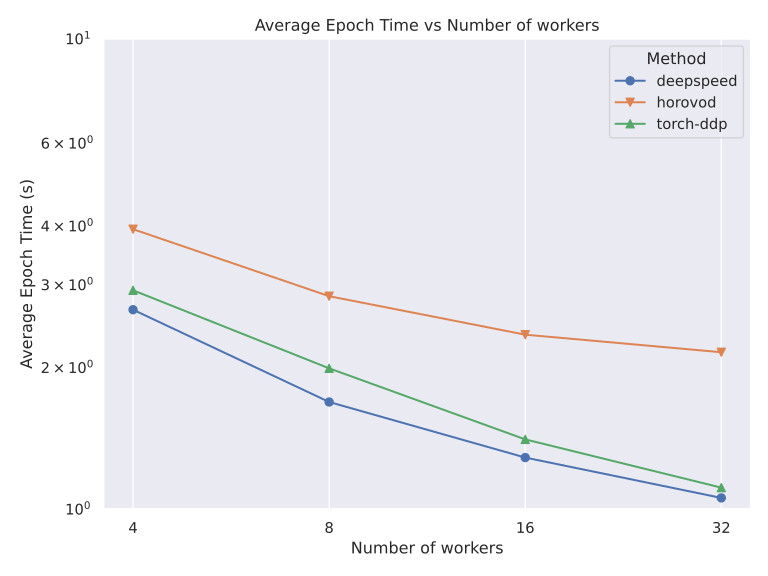
######## Epoch Time Report ########
     name  workers avg_epoch_time
deepspeed        4         2.65 s
deepspeed        8         1.69 s
deepspeed       16         1.29 s
deepspeed       32         1.06 s
  horovod        4         3.94 s
  horovod        8         2.83 s
  horovod       16         2.35 s
  horovod       32         2.15 s
torch-ddp        4         2.92 s
torch-ddp        8         1.99 s
torch-ddp       16         1.41 s
torch-ddp       32         1.11 s

No GPU Data Found

######## Computation Data Report ########
num_gpus  strategy computation_fraction
       4 deepspeed              75.47 %
       4   horovod              70.05 %
       4 torch-ddp              10.67 %
       8 deepspeed              30.66 %
       8   horovod              55.40 %
       8 torch-ddp               5.67 %
      16 deepspeed               9.52 %
      16   horovod              45.05 %
      16 torch-ddp               3.96 %
      32 deepspeed               4.80 %
      32   horovod              38.94 %
      32 torch-ddp               2.49 %
Virgo
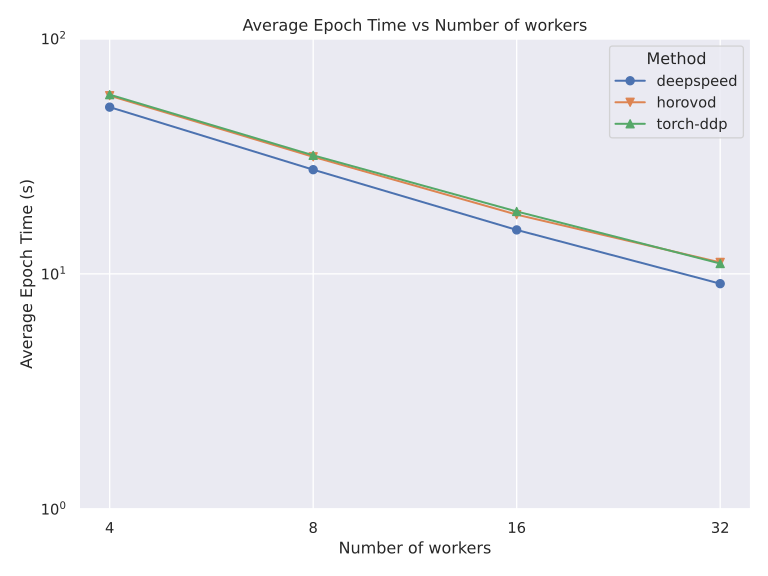
######## Epoch Time Report ########
     name  workers avg_epoch_time
deepspeed        4        51.18 s
deepspeed        8        27.74 s
deepspeed       16        15.38 s
deepspeed       32         9.09 s
  horovod        4        57.23 s
  horovod        8        31.46 s
  horovod       16        17.86 s
  horovod       32        11.19 s
torch-ddp        4        57.83 s
torch-ddp        8        31.92 s
torch-ddp       16        18.42 s
torch-ddp       32        11.07 s

No GPU Data Found

######## Computation Data Report ########
num_gpus  strategy computation_fraction
      4 deepspeed              54.03 %
      4   horovod              49.38 %
      4 torch-ddp              35.04 %
      8 deepspeed              53.97 %
      8   horovod              48.21 %
      8 torch-ddp              32.54 %
     16 deepspeed              53.88 %
     16   horovod              47.26 %
     16 torch-ddp              29.44 %
     32 deepspeed              53.67 %
     32   horovod              45.44 %
     32 torch-ddp              26.59 %
In both cases, data was collected for 4, 8, 16 and 32 GPUs for the DeepSpeed, Horovod
and PyTorch DDP strategies. The associated plots can be seen below:
Average Epoch Time Comparison
This plot shows a comparison between the average time per epochs for each strategy and number of nodes.
MNIST Use Case
Virgo Use Case
Relative Epoch Time Speedup
This plot shows a comparison between the speedup between the different number of nodes for each strategy. The speedup is calculated using the lowest number of nodes as a baseline.
MNIST Use Case
Virgo Use Case
Computation vs other
This plot shows how much of the GPU time is spent doing computation compared to other operations, for each strategy and number of nodes. The colored area represents computation and the shaded area represents other operations, e.g. communication. For each strategy, the columns are normalized to be between 0.0 and 1.0.
MNIST Use Case
Virgo Use Case